
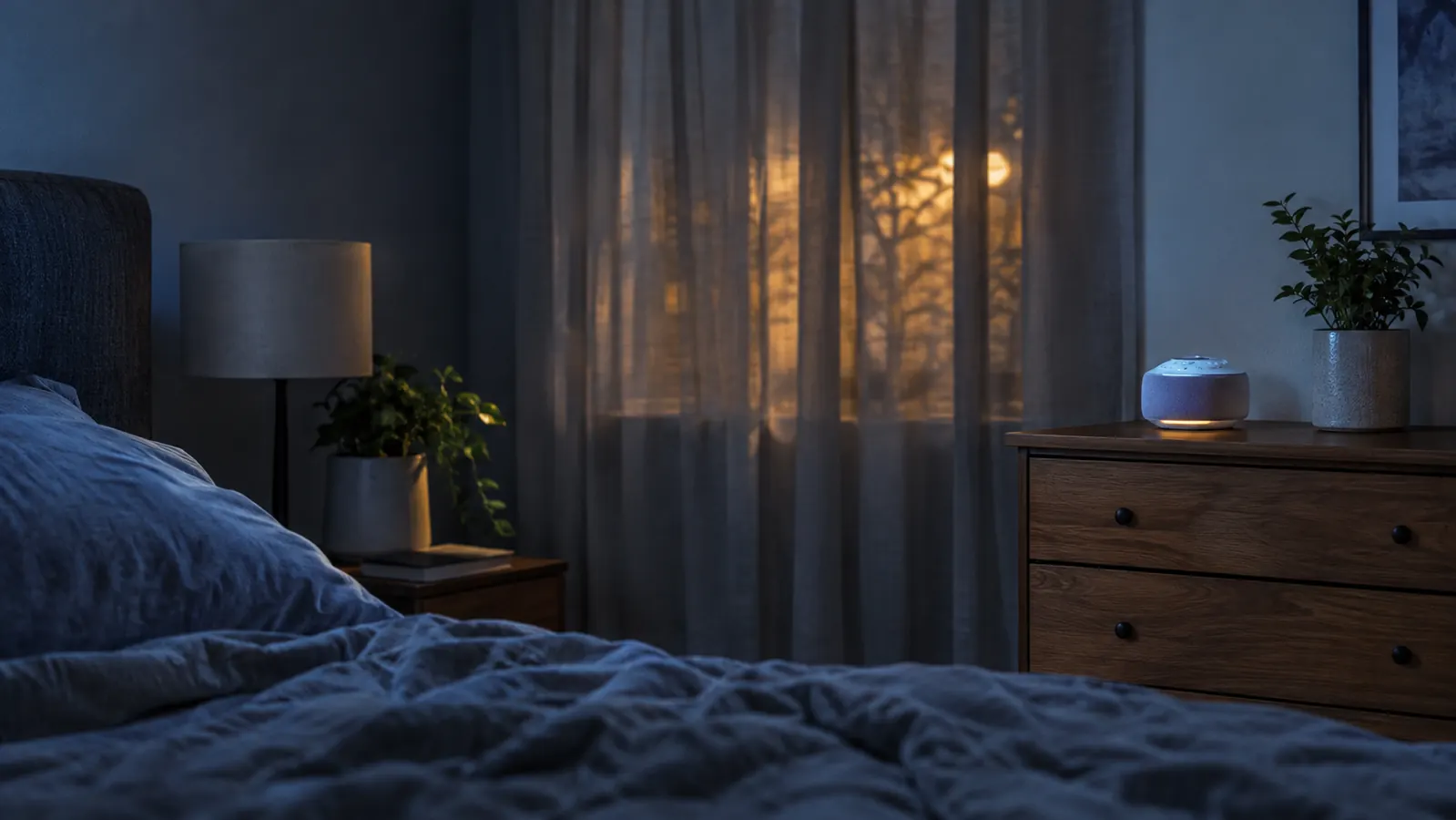
For a full year after I retired I woke up three or four times a night, and the first thing on the list I wrote at the kitchen table was noise. Not the television, not my wife Joyce. The forced air furnace that clicks and thumps when it starts, and the neighbor's pickup that fires up around five in the morning across the street. There is a streetlight outside the window too, but that was a different item on the list and it got a different fix. The noise item got a sound machine, and I have now owned two of them.
The first was a cheap plastic box from the drugstore with a recording inside it. The second is the YOGASLEEP Dohm Classic, which is a real fan in a small housing, and it has sat on my dresser across the room every night for about thirteen months, on the low setting, all night long. Here is the short answer before the long one. If the job is covering a furnace and a pickup at five in the morning, the Dohm is the one I would buy again. If you want a menu of sounds, a sleep timer, and something you can drop in a bag, an electronic machine does those things better and I will say so in plain terms below. YOGASLEEP sells one sound and two speeds, and that is the whole product.
| YOGASLEEP Dohm Classic | Electronic sound machine | |
|---|---|---|
| Sound source | A real fan moving air through a housing. One sound, low or high. | A recording played through a small speaker, usually a menu of them. |
| Loop | No loop. The fan runs as long as it is switched on. | The track repeats. On a short one you can hear where it begins again. |
| Sound choices | One. Fan noise, and that is the end of the list. | Usually rain, ocean, brook, birds and more. |
| Timer | No timer. It runs until you switch it off. | Commonly a sleep timer that fades the sound out. |
| Volume control | Two speeds, which change tone and volume together. | A separate volume control, usually with more steps. |
| Power | Corded electric, 7-foot cable, needs an outlet. | Often batteries, sometimes a cord. |
| Size and weight | 5.75 by 5.75 by 3.25 inches, 1.6 pounds. | Small and light, easy to pack in a bag. |
| Upkeep | Dust it. No app, nothing to pair, no batteries to change. | Change the batteries when they die. |
| Best for | Covering steady noise in one room, all night, every night. | Someone who wants variety, a timer, or sound they can carry. |
I am not comparing spec sheets here. Both machines have been in the same room, and the only question I care about is which one lets me sleep through a five in the morning pickup.
Where the Dohm Classic Wins
The difference is what your ear is actually hearing. The Dohm moves air. It is a fan in an ABS housing, 5.75 inches square and 3.25 inches deep, 1.6 pounds, plugged into the wall with the 7-foot cord that comes in the box. From the bed, what arrives is air moving at one pitch. There is no edge to it and no beginning. I lay there that first week trying to hear where it started and I could not, because it does not start anywhere.
The first night I set it on the dresser I flipped the switch, left it on low, and it covered the furnace and the pickup both. I want to be careful with that word. It covered them. It does not stop the furnace from thumping and it does not stop the neighbor from leaving for work. It puts a steady sound on top of them so my ear has something continuous to hold on to instead of a thump, then silence, then a truck. It took about a week before I stopped noticing the machine itself. Before that I was listening to it, which is a different thing from sleeping through noise.
Setting it up took less time than opening the box. The unit has a switch on it rather than a screen or a row of buttons, so there is nothing to program and nothing to read. I put it on the dresser, ran the 7-foot cord down behind the furniture to the outlet by the baseboard, and flipped the switch. That was the whole installation. I did try the high speed once that first night, just to hear what it sounded like, and it is louder and sharper in tone. I have run it on low ever since, every night for thirteen months. I know the high setting is there, but low has been enough for my bedroom.
There is also the matter of what is not in it. Nothing needs to pair with a telephone. Nothing needs to be updated. There is no battery door on the bottom that I have to remember, and no menu I could bump into at eleven at night with my eyes half shut. I unplug it only to dust under it, and that is the sum of the maintenance. When I think about the things that wore me out during the working years, none of them were machines that needed my attention at bedtime. This one asks for none, and I have come to value that more, not less, as the months go by.

Where an Electronic Sound Machine Wins
An electronic machine beats the Dohm on variety, and I am not going to pretend otherwise. Most of them give you a menu: rain, ocean, a brook, birds, a heartbeat, a fan if you want one. If you cannot sleep unless the sound is rain on a roof, a real fan is the wrong tool and no amount of praise for the Dohm changes that. Buy the machine that makes the sound you actually want. That sounds obvious written out, and yet people talk themselves into a fan because someone said it was the better one.
The timer is the second honest advantage. Plenty of people need help falling asleep and not help staying asleep. If that is you, a machine that plays for forty five minutes and then fades out is doing exactly the right job, and a box that runs all night is doing more than you asked it to. My Dohm has no timer at all. I do not miss it, but I am a man who wakes at four and wants the cover still running. That is my situation, not yours.
Portability and volume round it out. An electronic unit is small and light and many of them run on batteries, so it can go in a suitcase, a spare room, or a hotel. The Dohm weighs 1.6 pounds and needs an outlet, so it stays where you plug it in and that is that. Electronic machines also usually give you a volume control with more steps than two, and if you share a bed with someone who can hear a mosquito from the next room, being able to nudge the level down by a hair matters more than any other feature on this page.
One more point in their favor that I did not expect to care about: the volume control on an electronic unit moves independently of the tone. With my Dohm, turning it down to the low speed changes the pitch as well as the loudness, and the low speed is the one I want. On an electronic machine you can often keep the sound you like and simply make it quieter, so a person who finds the low setting still a touch too present in a small room has somewhere else to go. With a furnace to cover, that is not a problem I have. In a small apartment bedroom with thin walls and a neighbor on the other side, I can see it being the deciding factor.
One sound, on low, all night, no timer to fool with
The YOGASLEEP Dohm Classic is a real fan in a small housing. Two speeds, one switch, a 7-foot cord, and nothing to pair or update. It has run on low on my dresser every night for about thirteen months.
Amazon Check Today's Price on Amazon →What a Thirty Second Loop Actually Sounds Like
The machine I owned before this one recorded about thirty seconds of sound and played it over and over. Thirty seconds is not a long time. You learn it faster than you would think. I would be nearly under, and my ear would catch the small seam where the recording picked back up, the tiniest change in the hiss, and I would be awake and listening for it again. That is the part nobody tells you about a recorded loop. It does not sound bad. It sounds the same, and your brain is very good at finding the one spot where the same thing repeats.
What wore on me was the loop. There was a small hiccup in the background sound, once every half minute or so, like a breath being taken. A recording has to end and start over somewhere, and that is the spot your ear finds. Once you have heard it, you listen for it, and listening for it is the opposite of sleeping.
Not every electronic machine is that short. Some record minutes instead of seconds, and the better units hide the seam well enough that most people never hear it. But you cannot tell from the box, and you cannot tell in a store with the lights humming overhead. The only test that means anything is the one you run at home.
Your ear learns a loop in about a week, and then you spend the night waiting for the seam to come around again.
So here is what I would do if you buy an electronic machine. Set it up in the bedroom the day it arrives, at the volume you would actually sleep at, not the volume you would use to show it to somebody. Sit in the dark for ten minutes and listen. If you can find the repeat, you will hear it at two in the morning for years. If you cannot, keep it, because you found a good one. And if what you want is a sound with no seam in it at all, a fan is the only way I know to get there.

A Word About Placement, Because It Changes the Result
Where the machine sits matters more than which machine you buy, and I learned that in the first week. Mine is on the dresser across the room, not on the nightstand. Up close, a fan is a fan and you hear the motor in it. Across the room the sound spreads out and blends, and it stops being a thing making noise and becomes the background the whole room sits in. On a nightstand a machine is a device next to your head. Across the room it feels like the room itself.
The other part is what the machine sits on. A wooden dresser absorbs some of it. A hard surface will bounce it back at you. If the sound comes back sharp and you do not like it, try a folded towel underneath before you decide the machine is wrong, because sometimes it is only the furniture talking. And do not put it inside a closed cabinet or behind a chair back, which muffles the high end and leaves you with a dull throb that is worse than the furnace was.
Who Should Buy Which
Buy the Dohm if your problem is noise and nothing else. Furnace, traffic, a neighbor's truck, a house that creaks when the temperature drops. Buy it if you want the same sound from ten at night to six thirty in the morning and you do not want to think about it again. Buy it if you have tried an electronic machine and something about it bothered you that you could not put a name to. That was my situation exactly, and the name for it turned out to be the loop.
Buy an electronic machine if you know what sound you want and it is not a fan. Rain, ocean, birds, whatever it is. Buy one if a timer matters because you fall asleep fine and just need help getting there. Buy one if it has to travel, or if it is going in a room where an outlet is not handy. Those are real reasons and they are not small ones. There is no prize for picking the plainer machine.
And if you are where I was, up three or four times a night for a year with no explanation, see your own doctor before you buy anything at all. Mine checked me and found nothing that needed treatment, which was worth knowing. A sound machine covers a furnace. It does not fix a body, and anyone who tells you different is selling something.
Still the same one sound, thirteen months in
The Dohm Classic is 5.75 inches square, plugs in with a 7-foot cord, and has two speeds. No timer, no app, no list of sounds to scroll past at midnight. If the furnace is what wakes you, this is the plain fix.
Amazon Check Today's Price on Amazon →