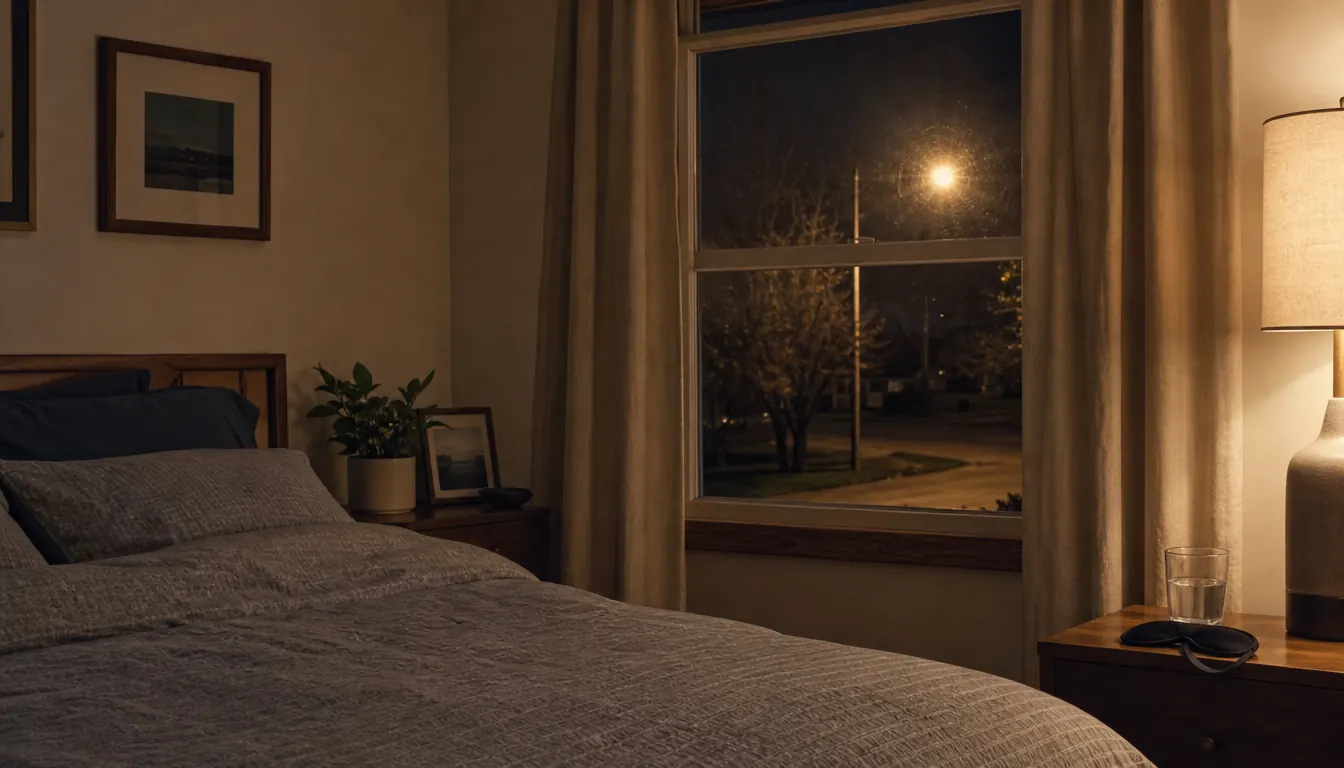
I put a sleep mask on for one reason: there is a streetlight on my street that shines straight through the plain curtains in our bedroom. I am 61. I spent thirty years on rotating shifts at a paper mill here in Green Bay, the last stretch of it as a shift supervisor, and when I retired I expected sleep to come back on its own. It did not. So last October I sat at the kitchen table with a yellow legal pad and wrote down the five things that were waking me or wearing me out. Light was second on that list, right after noise. The mask I ordered that week was the Manta Sleep Mask. The one it replaced was a flat foam eye mask I had bought at a drugstore during the bad year before that.
Here is the short answer. The Manta Sleep Mask blocks more light than a basic foam mask, and it does it by sitting around your eyes instead of on them. That is the whole difference, and once you have worn both it is not a small one. The foam mask is not junk. It covers your eyes, it costs almost nothing, and it takes up no room in a bag. But mine let light in at the nose, it slid up my forehead, and by morning it was usually somewhere near my ear.
| Manta Sleep Mask | Basic Foam Eye Mask | |
|---|---|---|
| Blackout at the nose | Eye cups sit around the eye and the adjustable strap pulls the fabric flat across the nose bridge, so there is no gap at the corners | A flat pad rests on the face, and light comes in where it crosses the nose and under the lower edge |
| Pressure on the eyes | The cups sit away from the eye, so nothing rests on the lashes and you can blink freely | The foam lies right on the closed lids and on the lashes |
| Side sleeping | The cup on the pillow side can press a little until the pillow is set right | Nothing to press, it lies flat against the pillow |
| Fit | Adjustable strap with a hook and loop closure | A thin elastic band with no adjustment at all |
| Cost | Costs more than a drugstore mask | The least expensive way to cover your eyes |
| Packing | The cups take up room in a bag | Folds flat enough for a shirt pocket |
| Care | I wash it by hand in the sink | Hand wash as well, and easy to replace when the foam goes flat |
| Getting it on in the dark | Two nights to learn where the cups go | Nothing to learn, you pull it on |
| Hold up over time | Thirteen months of nightly wear and it is the same mask that arrived | A foam pad and a thin band do not hold their shape forever |
| Best for | Nightly sleep in a room with a light outside | A nap, a flight, a hotel room |
What I Was Trying to Fix
Our bedroom window faces the street, and the streetlight sits right outside it. The curtains are plain and they stay up. Joyce likes the window, and I am not going to be the man who nails a blackout curtain over it. Joyce is 60, she sleeps cold, and she has never once complained about that light. She sleeps straight through it, every night. I am the one who wakes. When I made my list, light came second, after noise and before the sore neck, the overheating, and the dark winter mornings. The noise was the furnace clicking and thumping when it started, and a neighbor's pickup firing up around five. The light was the one I could do something about with a piece of gear.
Here is what the light actually did. It was not that the room was bright. It was that at three in the morning that lamp was the brightest thing in my field of view, and if I turned my head, there it was. I would wake, see it, and start the day's thinking at three in the morning. During the bad year before the list I was waking three or four times a night. I went to my family doctor and she checked me over and found nothing that needed treatment. It kept going, so I made the list.
A free fix like turning your back to the window only goes so far. It does not help at three in the morning, when that lamp is the only thing lit and my eyes have had four hours to get used to the dark. A room does not have to be bright to wake you. It only has to be brighter than it was when you closed your eyes.
The Foam Mask Came First, and Why I Went Looking Again
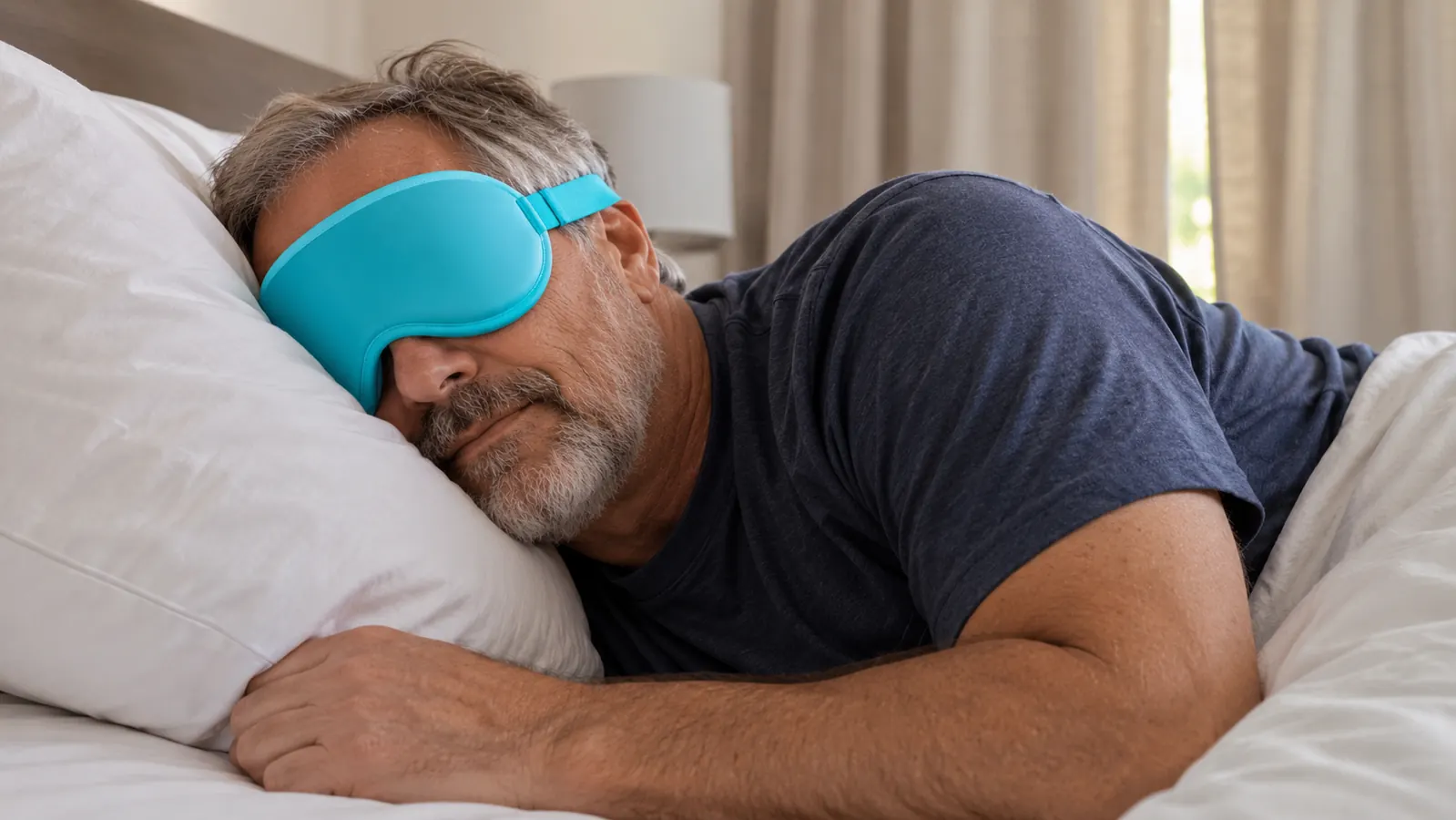
The flat foam mask came from a drugstore during that bad year, well before the list and not in the October order. It was better than nothing, and I want to be fair to it. It covered my eyes. The problem was the edges. Light came in where the pad crossed my nose, and it came in under the bottom edge when I rolled onto my side. It also slid. I would put it on straight and wake up with it pushed up on my forehead. It lives in a drawer now. I never wore the two side by side, so what I am comparing is a memory of one against thirteen months of the other.
The one I had was a foam pad about the size of my palm on a thin elastic band with no adjustment anywhere on it. There was no way to tighten it and no way to loosen it, so it fit the way it fit. The foam flattened with use and the band went slack, which is not a complaint about a mask that costs so little. It is what foam and elastic do. I washed it in the sink the same way I wash the Manta Sleep Mask now, and it held together fine.
That is the thing I did not understand until I had both. Covering your eyes and blocking light are two different jobs. A flat pad covers. It cannot seal, because your face is not flat, and the place it fails is the place a face has the most shape, which is the nose. Once I figured that out, I stopped looking for a thicker foam mask and started looking for one built around the eye instead of on it.
Where Manta Sleep Wins
The Manta Sleep Mask has eye cups that sit around your eyes rather than on them, and the strap is adjustable with a hook and loop closure, so you can pull the whole thing in until the fabric runs flat across the nose bridge. That is the leak I could never fix on the foam mask. The first night, the difference was obvious at the nose. It took me two nights to get the cups placed where I wanted them, one over each eye without pressing, and about a week before I stopped thinking about the mask at all.
What the adjustable strap bought me was slack. The foam mask was one size and I was whatever size it happened to be. With this one I can set it so the fabric runs flat across my nose without pulling the cups in against my brows, and finding that took two nights. The first night the cups were too close together. The second night I moved them out and the seal at the nose held.
The second thing is pressure. The cups sit away from your eyes, so nothing rests on your lashes and you can open your eyes behind it without rubbing. That mattered more than I expected, because the foam pad lay right on my closed lids and every time I blinked I felt it. The whole mask weighs 3.21 ounces and the materials are soft and breathable, so on a warm night it does not turn into a hot spot. In thirteen months it has never come off by itself. Not once. The foam one came off most nights without any help from me.

Where a Basic Foam Eye Mask Wins
Now the other side, because there is one, and it shows up every night for me. I sleep on my side. The cup on the pillow side can press a little, and I have to set the pillow so my face is not buried in it. Some nights I get it right the first time and some nights I fuss with it. The foam mask has no cup to press. It lies flat, the pillow takes it, and that is the end of it. If you are a committed side sleeper who rolls all night long, that flatness is worth more than it sounds.
What I do now is sleep with my face far enough forward on the pillow that the cup on that side sits in the hollow instead of on the rise. It works, and it took a while to find. It also means I am more aware of where my head is than I ever was in the foam mask. I am not going to tell you a contoured mask disappears when you roll onto your side. It does not. It is fine, and fine beats a pad that has slid up onto my forehead by two in the morning.
The rest of the foam mask's case is simple. It is the least expensive way to cover your eyes, it folds flat enough for a shirt pocket, and there is nothing to learn. You pull it on and you are done, in the dark, half asleep, with no strap to find. A mask you need twice a month on a plane, or in a hotel room with a light over the desk, is a foam mask and nothing more, and I would not talk anyone out of one for that. I would only say that a mask you wear for eight hours a night in a room with a streetlight outside is a different purchase.
If the light is what wakes you, start with the one that closes the gap at the nose
The Manta Sleep Mask is what I have worn nightly for about a year. It seals where the foam mask leaked and it has never slid off in the night. Current price is on the listing.
Amazon Check Today's Price on Amazon →What Thirteen Months of Nightly Wear Looks Like
The mask goes on at bedtime, every night. Most nights it comes off at the four o'clock trip to the bathroom and lands on the nightstand, and that is where it stays until morning. That is not the mask failing. That is me, half asleep, not bothering to put it back on. On the nights I sleep straight through with it on, it is still in place when the alarm goes. I hand wash it in the sink about once a month and it has held up fine. Same mask as the one that arrived in October.
The part I did not expect is that it has not stretched out of shape. The strap closes on the same spot it did in the first month, and the cups have not gone soft. The foam mask was a different story. The band was slack and the pad was thin enough that I could see light through the middle of it. Thirteen months in, this one looks like a mask that has been used, not one that is used up.
Two honest complaints. The first is the side-sleeping press I already described, which is a pillow problem as much as a mask problem. The second is that when I take it off at four in the morning, the sunrise from the lamp on my nightstand reaches me, and on a morning I sleep through with the mask still on, the bird sound wakes me instead. Those two pieces of gear do not fully work together and I have not solved it. If I were scoring the mask on its own I would put it at 8.4 out of 10, four and a half stars, with the half point off for that side-sleeping press.
Covering your eyes and blocking light are two different jobs. A flat pad covers. It cannot seal.
Who Should Buy Which
Buy the Manta Sleep Mask if the light in your room is the thing that wakes you, if you wear a mask most nights rather than a few times a year, and if you want nothing touching your eyes. It is also the one to pick if you sleep on your back, because the cups sit clear of your face and there is nothing to press. If you have tried a drugstore mask that leaks at the nose and ends up on your forehead by morning, this is the upgrade that stops that. The adjustable strap is what makes it work on a face that is not the size the foam masks are cut for.
Buy the basic foam mask if your need is occasional. A nap on a plane, a bright hotel room, a summer weekend at somebody else's house. Buy it if you cannot stand anything strapped to your head and you would rather have a light leak than a strap. Buy it if the money matters this month, because it is the least expensive way to cover your eyes and it does cover them. And if you are a hard side sleeper who has tried a contoured mask and hated the press of a cup against the pillow, the foam one is honestly the better fit for you.
Block the light, not the sleep
Thirteen months, one hand wash a month, still the same mask. If a streetlight is what wakes you at three in the morning, this is the mask I would buy again.
Amazon Check Today's Price on Amazon →