
I bought the YOGASLEEP Dohm Classic in October of last year, in one Amazon order along with four other things I had written down on a yellow legal pad at the kitchen table. Noise was first on that list. Thirty years of rotating shifts at the paper mill had me waking three or four times a night, and after I retired at fifty-nine it did not straighten itself out the way I assumed it would. So this is not a review from a man who read the listing. This is from a man who has had the thing running on his dresser every night for thirteen months, through one winter and one summer, and who has a few plain things to say about what it does and what it does not.
Here is the short version. It worked the first night, it has worked every night since, and it is about as complicated as a light switch. One sound, two speeds, no timer, no menu. If you are expecting a piece of technology you can adjust, you will be disappointed by it. If you want the noise in your house to stop pulling you out of sleep, it will do that, and it will do it without asking anything of you. What follows is the honest version, including the parts that surprised me and the parts that still irritate me a year later.
The Quick Verdict
One sound, two speeds, no timer. It covered the furnace and the neighbor's pickup on the first night and has covered them every night since. Buy it for the plainness, not in spite of it.
Amazon Check Today's Price →The Fan That Covered My Furnace on the First Night
Two speeds, one switch, and a seven-foot cord that reached the outlet from my dresser. Thirteen months on, it has not moved and it has not needed anything from me.
Amazon See the Current Price on Amazon →How I've Used It, Night After Night
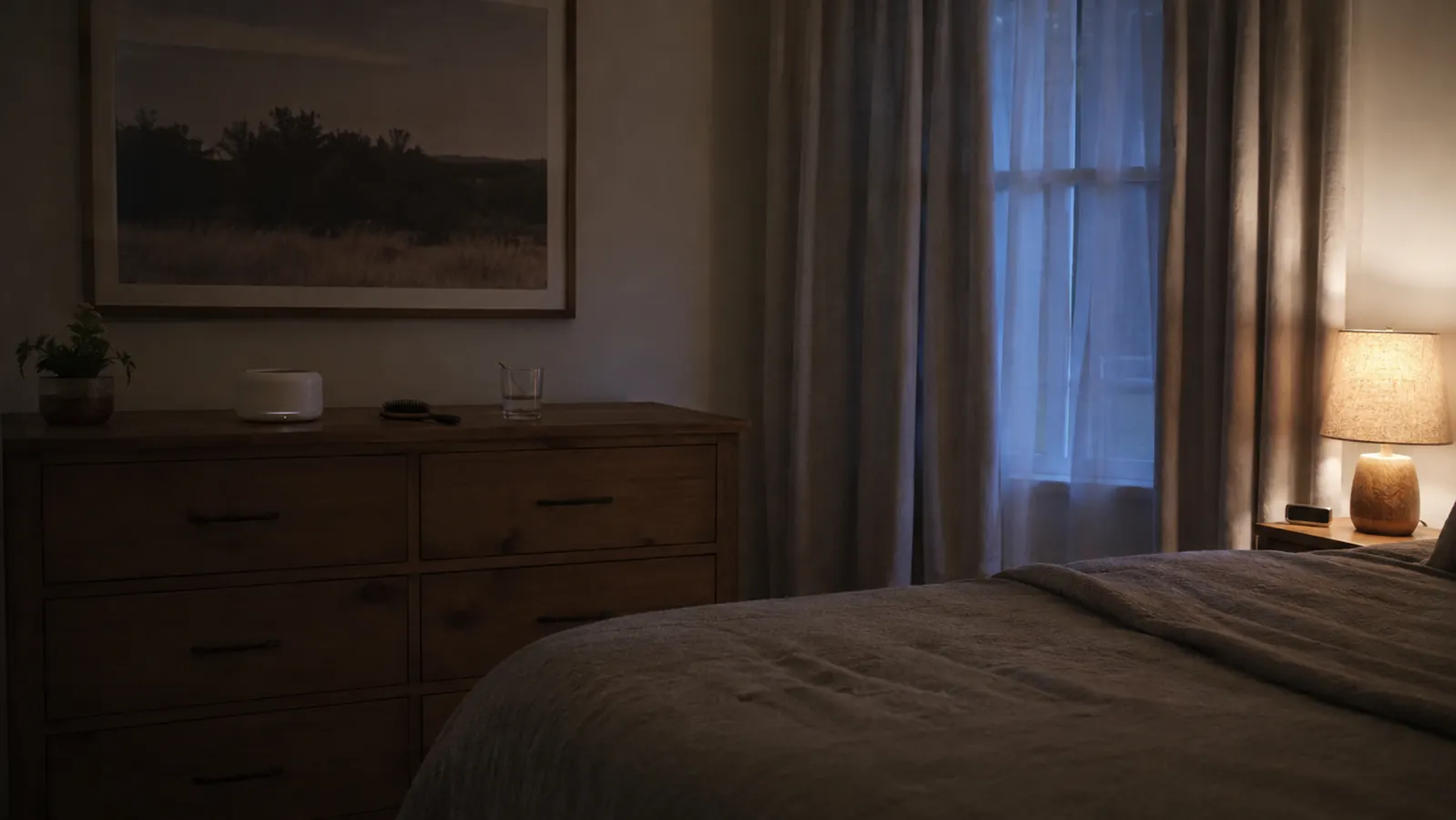
The YOGASLEEP Dohm Classic sits on my dresser, across the room from the bed. I put it there the night it arrived and it has not moved since, not to the nightstand, not into another room. The only time it is off is when I unplug it to dust underneath it, which happens a few times a year.
It runs on the low speed, all night, every night. The first night I flipped it to high just to hear what the second setting did, and I have not used high since. Low fills the room. If your house is louder than mine, or the fan ends up closer to your head, high is there and it is noticeably more sound, not a small step up.
My wife Joyce did not mind it from the start, which surprised me. She sleeps cold and I sleep hot, and I expected the fan to be a negotiation. It was not. The sound does not cool the room, it just fills it, so she had nothing to object to. She gets up later than I do and the fan is off by then anyway, since I switch it off when I get up.
Thirteen months is a full winter and a full summer, and it is November again now. The motor sound has not changed in that time. Nothing has come loose and started to rattle. It is a small thing, 5.75 by 5.75 by 3.25 inches and 1.6 pounds, with a plastic housing and a fan inside, and there is honestly not much on it that could fail. Yogasleep has been building these for over sixty years according to the listing, and it shows in the boring way you want a bedroom appliance to be boring. The warranty is one year limited, which I have not had to use.
It Covers Noise. It Does Not Remove It.
This is the part I most want you to understand before you spend anything. The fan does not make your house quiet. It puts a steady sound into the room so the other sounds matter less. The forced air furnace still clicks and thumps when it kicks on. The neighbor's pickup still starts up around five in the morning. I hear both of them the way you hear a car go by while you are talking to somebody at the table. It registers, and then it is gone, and you carry on.
If what you want is a silent bedroom, this is the wrong purchase, and no sound machine is the right one. You cannot subtract sound from a room by adding more sound to it. What you can do is give your ears something steady to rest on, so a thump at the wall does not pull you all the way up out of a sleep.
The difference on a bad night is not that the noise goes away. It is that the noise stops being an event. That is the whole trick, and it took me about a week of nights to be able to say it that plainly.
One more thing on this. The sound is a fan, so it is the sound of moving air, not the sound of rain or waves or a recording of a forest. Some people find a fan more natural than an electronic loop and some find it flat. I am in the first group, and I did not know that about myself until I had both in the same house.
Two Speeds, One Switch, and Nothing Else
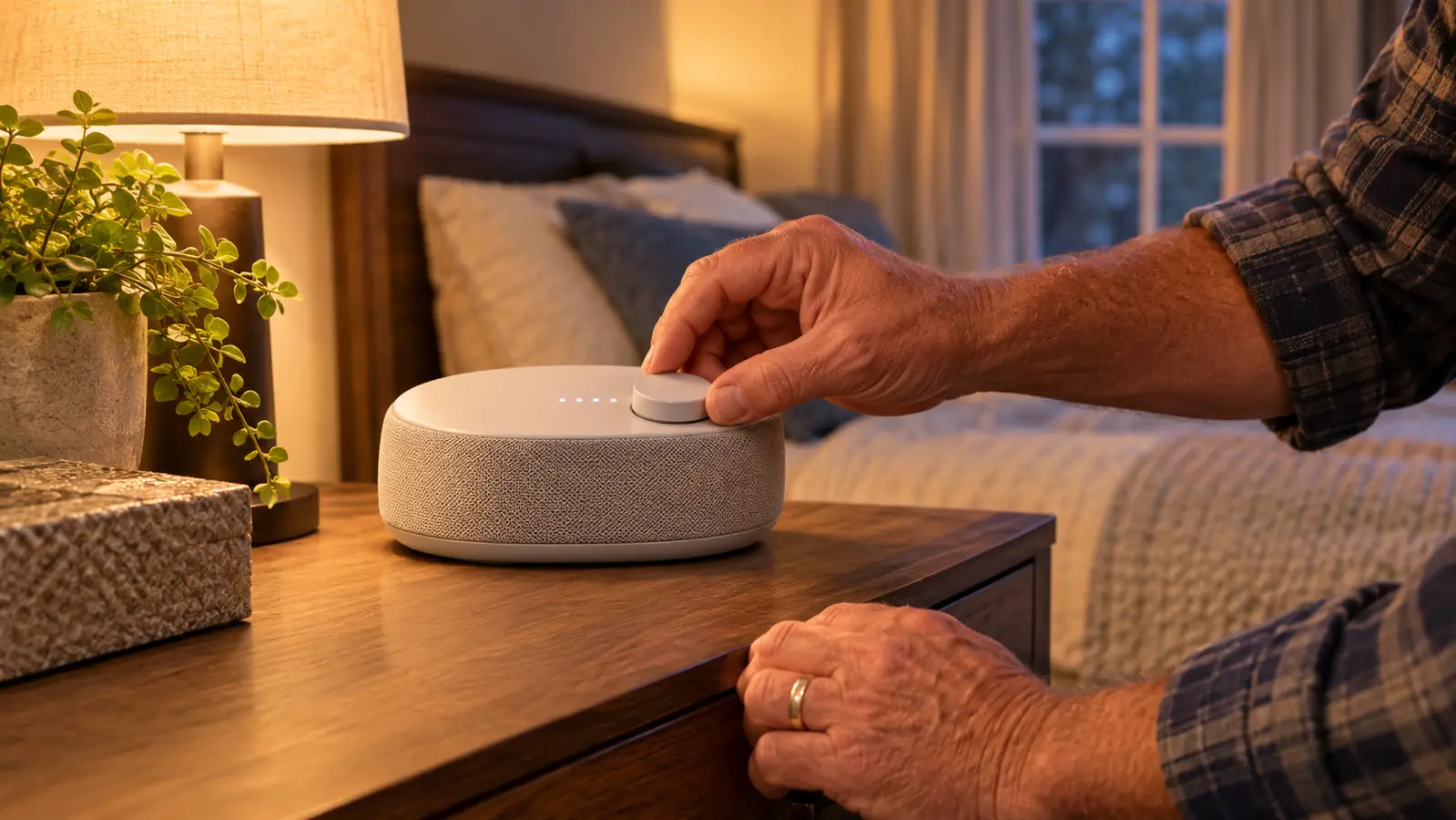
The controls are a switch. That is the entire control panel. Off, low and high, and you flip it and walk away. There is no timer, so it does not shut itself off at midnight or come on at ten. There is no volume dial past choosing between the two speeds. There is no second sound to pick, no fan and rain, no fan and birds, no twelve-sound menu. It is one fan sound, and the two settings decide how much of it you get.
For the first week I thought the missing timer was a genuine fault and I was ready to call it one. Then I thought it through. Anything with a timer is a thing you have to set, and a thing you have to set is a thing you can set wrong, in the dark, half asleep, at four in the morning. I have come around to the switch. I flip it on when I get into bed and that is the last decision the machine asks of me until the alarm goes.
Power comes from a cord, not a battery. It ships with a seven-foot cable, which reached the outlet from my dresser without an extension cord, and it plugs into a standard 120 volt wall outlet. If the power goes out in the night the fan stops, and it stays stopped until the power comes back. That is worth knowing if your power flickers, because a fan that quits is a fan that quits, and you will notice the room go quiet before you notice anything else.
The plainness is also why I stopped noticing it. A machine with settings invites you to fiddle, and fiddling at three in the morning is its own kind of wakefulness. There is nothing on this one to fiddle with, so the question of whether it is set right never comes up.
The First Week Is Not the Reason You Bought It
The night it arrived, the fan covered the furnace and the pickup and I slept better than I had in a while. What nobody told me is that for the first several nights you hear the machine itself. It is a new sound in a room you know by heart, and your ears keep checking on it the way they check on a new refrigerator.
That faded in about a week. Somewhere around the sixth or seventh night I stopped noticing that a fan was running and started noticing only when it was off. That is the point where a sound machine quits being a gadget you bought and becomes part of the room, and it is the point where you stop being able to judge it fairly.
So do not judge it on night one, and do not judge it on night three. Give it a week of ordinary nights. If the sound itself still grates on you after seven nights, it is probably the wrong sound for your ears, and that is a fair reason to send it back. If you have stopped hearing it, you have gotten what you paid for.

What the Old Machine Did Wrong
Before this one I had a cheap electronic sound machine from the drugstore. It played a recording on a loop about thirty seconds long. Once I noticed where the loop started over, I could not stop hearing it. Every thirty seconds, the same little seam in the sound, like a page turning in the next room. It lives in a closet now.
That is the difference between a fan and a recording, and it is the reason I went looking for a real fan this time. A fan makes its sound continuously, so there is no beginning and no end for your ear to catch. I have listened for a seam in this one for thirteen months and there is not one to find, because there is nothing looping.
If you have never owned a sound machine, that will sound like a small complaint. If you have owned one with a recording in it, you know exactly the seam I mean, and you know how completely it ruins the thing once you hear it.
The Things That Still Irritate Me
Only two speeds and one sound. That is the honest gripe and I am not going to dress it up. There are nights I would like the fan slightly quieter than low and there is no way to get there. There are also nights, fewer of them, where I would like a different character of sound entirely and the machine cannot give me one. What it does, it does well, and what it does is narrow.
No timer. I said I came around to it and I meant that, but there are mornings I am up before the alarm and I would like the fan to go off on its own rather than lie there listening to it. It does not. I switch it off. That is the arrangement.
It needs an outlet. There is no battery and no cordless version, so it lives where the cord reaches and it does not travel. If you want something to take to a motel, this is not the thing, and you will want to look at a small portable machine instead.
And the last one is not the machine's fault but it is worth saying. It covers noise rather than removing it, and if your bedroom is genuinely loud, a fan at low speed is not going to be enough. There is a ceiling to what a covering sound can do, and you find it the morning somebody runs a snowblower outside your window.
What I Liked
- Covered the furnace and the neighbor's pickup on the first night and every night since
- A real fan, so there is no loop and no seam for your ear to catch
- Two speeds and one switch, so there is nothing to set wrong in the dark
- Small enough to sit on a dresser, 5.75 by 5.75 by 3.25 inches and 1.6 pounds
- The seven-foot cord reached the outlet without an extension
Where It Falls Short
- Only two speeds and one sound, with nothing in between
- No timer and no auto-off, so you switch it yourself
- It covers noise rather than removing it
- Corded only, so it needs a wall outlet and stays put
- You hear the machine itself for the first week
It does not make the house quiet. It makes the furnace and the pickup stop being events, and after thirteen months I can tell you that was the entire job.
Who This Is For
This is for somebody who is being woken by ordinary household sound. A furnace that thumps when it starts. A refrigerator that cycles. Traffic on a street that does not go quiet. A neighbor's truck starting before dawn. A house that creaks when the temperature drops. If that is the shape of your bad night, a steady fan in the room is a sensible answer, and it works on the first night rather than after a month of practice.
It is also for somebody who does not want to think about their bedroom equipment. The YOGASLEEP Dohm Classic has two settings and a switch, and once you have picked one there is nothing more to manage. If you have ever lain awake half the night wondering whether the app on your phone was set correctly, you will understand why that matters more than a longer menu of sounds.
Who Should Skip It
Skip it if you need silence. It will not give you silence, and no sound machine will. Skip it if you want choices, because there are none here: no rain, no ocean, no birds, no timer, no gradual fade, no volume dial past the two speeds. A machine with all of that exists and this is not it. Skip it if you need something cordless or battery powered, because this one wants a wall outlet and a dresser to sit on.
And skip it if the sound of a fan itself bothers you. Some people cannot settle with moving air noise in the room, and nothing here softens the character of it. There is no adjustment that makes a fan sound like something else. Low or high, and that is where the options end.
One Switch, One Sound, Thirteen Months of Covered Noise
It is not a fix for a bad sleeper and it is not a gadget. It is a small fan that covers the noise in the room, and after a year on my dresser I would order it again without thinking twice.
Amazon Check Today's Price on Amazon →