

Six thirty in the morning in Green Bay in December does not look like morning. The window is black. The streetlight out front is still burning. The only thing telling me it is time to get up is an alarm. For most of my working life that alarm was a plain digital clock with a buzzer, set for 4:40 on early shifts, and I did that for thirty years at the paper mill. A buzzer does not convince your body of anything. It just turns getting up into an argument you lose every morning, and then you carry that loss into the rest of the day.
You will hear the usual advice. Go to bed earlier. Set two alarms, ten minutes apart. Put the phone across the room. None of it touches the real problem, which is that at 6:30 in January there is no morning in the room for your body to notice. Being startled awake and being woken up are two different events. What put morning in the room was a light. Mine is the Philips SmartSleep Wake-up Light, the HF3520, and it has sat on my nightstand since the day it arrived about thirteen months ago. It starts glowing at 6:00 for a 6:30 alarm. What follows is how I set it up, in the order I would do it again if I had to start over.
The half hour before your alarm is the part that does the work
The Philips HF3520 begins its sunrise at 6:00 and reaches full light with a natural wake sound at 6:30. Five sounds to choose from, tap snooze, and a display that dims itself so the room stays dark at night.
Amazon Check Today's Price on Amazon →Step 1: Put it where the light can actually reach you
Mine sits on the nightstand, roughly at the height of the pillow, turned toward the bed. That is the entire install, and it took about as long as plugging in a lamp. The mistake I would warn you about is putting a wake-up light across the room on a dresser. Then it is a reading lamp on a timer, because the whole point is light landing on your face while you are still lying down with your eyes shut. Light has to travel. The shorter the trip, the better it works.
Distance matters more than any setting, at least at the start. A lamp two feet from your head at 6:00 does something a lamp ten feet away does not, no matter how bright you make it. If your nightstand is already crowded, know that this one takes up real space. It is a round tabletop lamp, not a slim clock. My wife Joyce gets up later than I do and turns her face away from it in the mornings, and I do not blame her.
The one honest limit is my sleep mask. I wear a contoured mask because of the streetlight, and on a morning I sleep straight through with it on, the sunrise does nothing and the bird sound is what wakes me. So if you wear a mask too, go in knowing the two do not fully cooperate. Some mornings you get the light. Some mornings you get the sound. Both beat a buzzer, but only one of them is the thing you bought the lamp for.
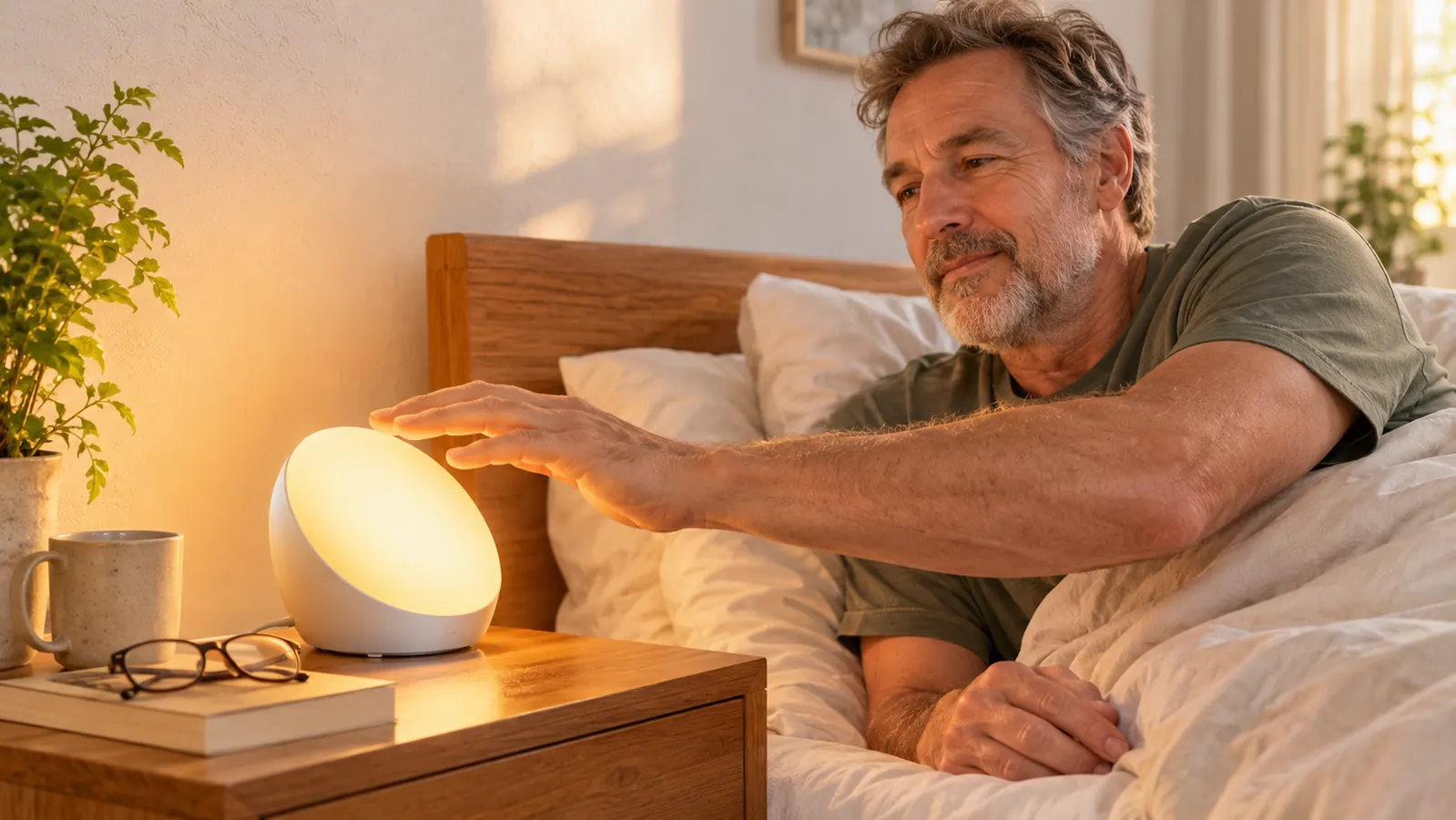
Step 2: Start the sunrise half an hour before you need to be up
The light begins at 6:00 and builds until the sound comes at 6:30, which is also when I need to be out of bed. Long enough to be gentle, short enough that I am not lying there at 5:15 wondering why the room is getting orange. In December the real sun in Green Bay is not up until well after I am, so for a couple of months the lamp is doing something the sky has no intention of doing.
Set the wake time to the time your feet actually hit the floor, not the time you wish you got up. I know how that sounds. But an alarm set for 6:00 when you really get up at 6:40 just gives you forty minutes of negotiating with yourself in a bright room. Pick the honest time. You can move it earlier later, once getting up stops being a fight. That order matters. Move the alarm first, then the habit.
The other setting worth ten seconds of your time is the display. The Philips display dims itself automatically, which sounds like a small thing until you have spent a night with a clock face glowing at you from three feet away. A bright clock and a dark room are working against each other. Let the thing go dim. That is what the setting is for.
Step 3: Pick a wake sound you can stand for three hundred mornings
There are five natural sounds to choose from. I picked the birds, and I have not changed it in thirteen months. My advice is to pick the one with some texture to it, something that sounds like it came from outside a window, rather than anything that beeps, chimes, or pings. You are going to hear it several hundred times. Pick the one you will not start to hate.
The sound comes at the end of the sunrise, not the beginning. By the time the birds start, the room is already lit and I have usually been drifting in and out for a while. That sequence is the whole trick. The light does the persuading. The sound only has to finish the job. A buzzer tries to do both at once, which is why a buzzer feels like being grabbed.
Snooze is a tap, not a hunt for a button in the dark, which matters more at 6:30 than you would think. I have hit it maybe a dozen times in thirteen months. If you are someone who hits snooze four times every morning, this will not cure that, and I would not want you to buy it expecting a cure. It makes the first minute easier. It does not make you a different person.

Step 4: Let it handle the end of the night too
The Philips lamp has 20 brightness settings, so it works as a bedside reading lamp. I turn it down low, read for a while, then shut it off. That is a second job for something that already had a spot on the nightstand, and it is the reason I stopped resenting the space it takes. Two jobs for one plug is a fair trade in a small bedroom.
The sunset is the other half of that. It eases the light down over time instead of you flipping a switch and going from bright to black. I use it a couple of times a month, not nightly. It is a good thing to have and it is not the reason to buy the lamp. If you already have a bedside lamp you like, you will not miss it. If you do not, you will use it more than you expect.
The FM radio is in there too. I turned it on once to see that it worked. It does. I have not turned it on since, because I am not a radio man at 6:30 in the morning and I suspect most people are not. On the honest side of the ledger, it does cost more than a clock, and it takes up more of the nightstand than a clock. The sunrise is what you are buying, and the rest is along for the ride.
Step 5: Give it two weeks and judge the right thing
My two weeks landed in early November, which is exactly when Green Bay stops pretending to have daylight. Somewhere in that stretch the dark mornings stopped feeling like a wall I had to climb. I did not notice it on one particular morning. I noticed that I had stopped dreading the alarm, which for me is a bigger deal than it sounds. Thirty years of shift work teaches you to dread an alarm in a way that is hard to explain to somebody who has not done it.
So when you are judging it, judge the getting up, not the waking up. Nobody leaps out of bed in January. The question is whether the first minute is an argument or just a minute. For me it went from an argument to a minute, and that has held through one full winter of dark mornings. It is a small change and it is the one I notice every single day between November and March.
If two weeks go by and mornings are still miserable, the lamp is not the answer for you, or not the only answer. Mine sits on a nightstand in a house where four other things are also doing their part, and I would be lying if I said the lamp did it alone. I will also say this plainly. If sleep trouble goes on for months, see your own doctor. A lamp is a lamp. It is not a diagnosis, it is not a treatment, and it is not a substitute for somebody who knows what they are looking at.
What Else Helps
In October of last year I sat at the kitchen table with a yellow legal pad and wrote down five things that were waking me or wearing me out. Noise, light, a sore neck, overheating, and dark mornings. That was the whole list, and it went into one order. The Philips wake-up light covers the last item on it. That is all it covers. If your mornings are bad because a neighbor's pickup starts around 5am, or because a streetlight is coming through the curtains, a sunrise lamp will not fix that, and I would rather tell you now than have you find out in February.
Noise got a sound machine on the dresser across the room, on low, all night, and it covered the furnace the first night. The streetlight got a contoured sleep mask. Those are separate jobs and neither one is the lamp's job. There is no single purchase that handles a list like mine, and anyone who tells you otherwise is selling something.
The rest of it is unglamorous. I am in bed around 10 and the alarm is 6:30. Most nights I wake once, around 4, for the bathroom and go back to sleep. Bad nights still happen, and I do not pretend otherwise. I do not wear a tracker and I do not keep a log of hours, so I cannot give you percentages or a sleep score and I would not trust anyone who hands you one from their own bedroom. What I can tell you is that mornings are easier than they were, and that the lamp is the piece of it that changed the first half hour of the day.
I have hit snooze maybe a dozen times in thirteen months. That is most of the review, honestly.
If dark mornings are the thing wearing you down, start with the light
The Philips HF3520 runs a 30 minute sunrise, five natural sounds, tap snooze, and a display that dims itself. It made the first half hour of the day feel like something other than a fight.
Amazon Check Today's Price on Amazon →